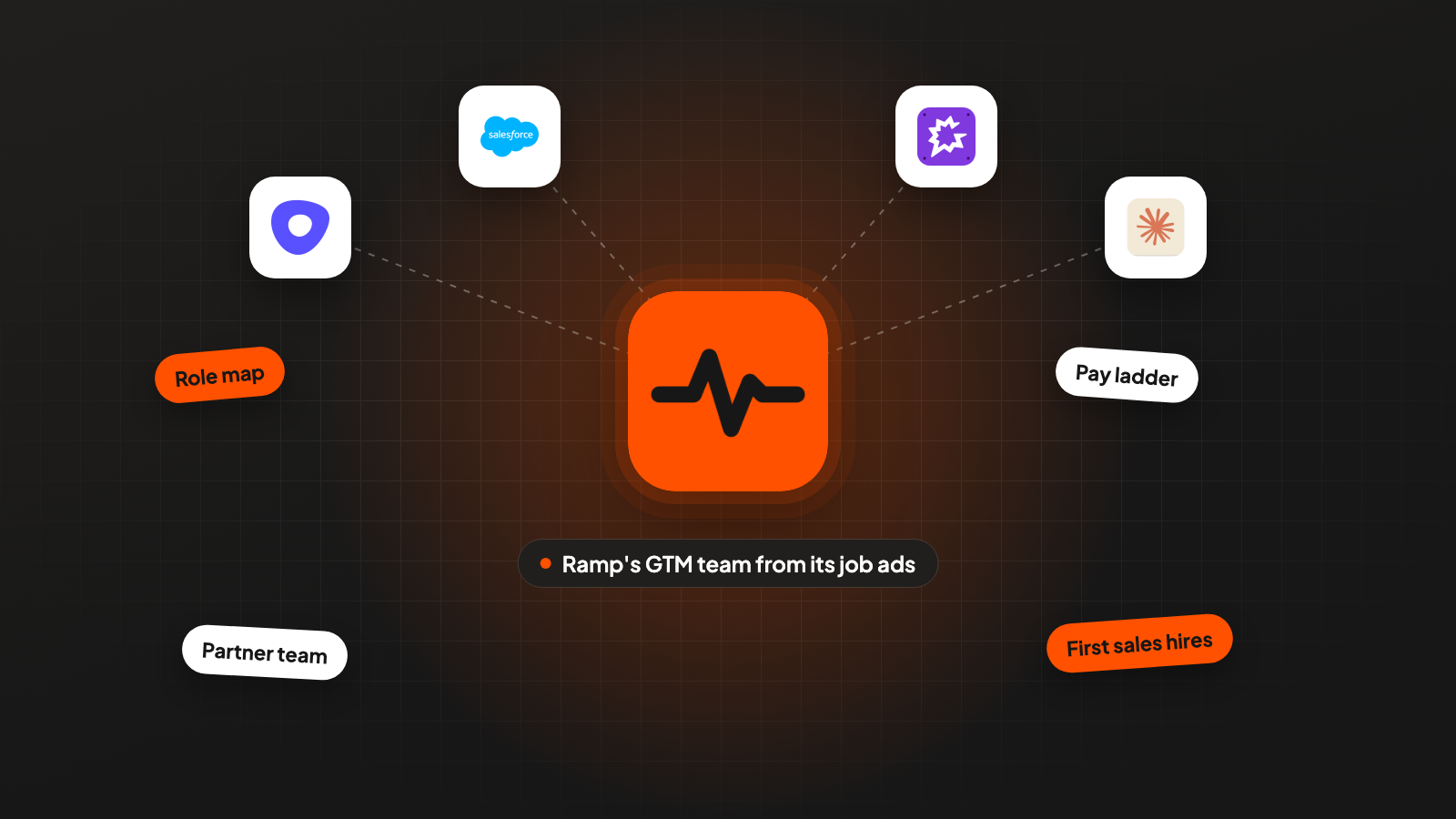
This is a breakdown of Ramp’s go-to-market (GTM) team, the people who win and keep customers, based on the job ads on its public job board. At the end, I turn it into a plan for your first sales hires.
Ramp sells corporate cards and finance software, like bill pay and procurement tools. It has 168 open roles. 77 of them are in Sales, Marketing and Business Development, and Ramp files its customer success and partner teams inside these three. 70 of the 77 ads show a pay range.
The biggest share of these roles works with customers who have already signed. Activation managers, who get a new customer to use Ramp, and account managers, who grow existing customers, have 25 open roles together.
Winning new customers has 18 open roles: 8 for SDRs (sales development reps, who book first meetings) and 10 for AEs (account executives, who close the deal).
This breakdown is for founders who are about to hire their first sellers, and for sales leaders who want a benchmark for roles, pay and quotas. Read it in order, or skip to “What to copy for your first GTM hires”.
How I collected and counted the ads
Ramp posts its jobs on Ashby, an applicant tracking system: software that companies use to publish job ads and manage applicants. Ashby makes every company’s job board public as data a script can download, with no login and no API key (the password many data services require).
I downloaded all 168 ads with the script near the end and grouped the 77 GTM roles by the team name Ramp gives each ad. Then I went through every ad for pay, deal sizes and tool names.
Every ad starts with the same company intro. So when I count how often a word like AI or Salesforce appears, I count it only in the part of the ad that describes the role.
Two limits to keep in mind. An open role shows where a company is adding people. It doesn’t show how big the team already is, and one ad can be for several hires. And job boards change every week, so all numbers are from the day I downloaded the ads.
The role map: 77 roles in 10 teams
Ramp files every GTM ad under a team. Here are the ten teams, sorted by open roles.
| Team | Open roles | What the titles say |
|---|---|---|
| Customer Success Management | 17 | Customer Activation Managers by customer size, technical consultants for ERP systems |
| Channel Sales | 14 | Partner Development Reps, Channel Partner Managers, partner consultants |
| Account Executive | 10 | Commercial, Mid-Market, Enterprise, Strategic, public sector, Canada, London, 3 managers |
| Account Manager | 8 | Commercial, Mid-Market, Enterprise, Strategic, Canada, 3 managers |
| SDR | 8 | SMB, Mid-Market, Strategic Accounts, Canada, London, 3 managers |
| Solutions Consulting | 7 | Solutions and Technical Consultants by customer size, public sector, procurement |
| Growth Marketing | 6 | Brand operations, performance, social, paid social, design, brand partnerships |
| Sales (other) | 3 | AI Solutions Engineer, Engagement Manager, one Enterprise sales development manager |
| Product Marketing | 2 | New products, industries |
| Business Development | 2 | AI partnerships, AI solutions |
Solutions consultants are product experts who join sales calls and give demos. Channel Sales is the partner team. An ERP is the main accounting system of a large company.
Four customer-facing teams use the same customer-size labels. Ramp sorts customers into segments by company size: SMB (small and medium businesses, also called Scaled), Commercial, Mid-Market, Enterprise and Strategic. You find these labels in SDR, AE, account manager and activation titles.
I think the segment is how Ramp organizes its GTM team. Each of these teams has people for each segment, so one customer goes from an SDR to an AE to an activation manager who all work the same segment.
Ramp also has 6 open roles in Growth Engineering, outside the 77. Three of them are GTM business systems roles: the people who build and run the sales software. The section on systems covers them.
Most open roles are for the step after the contract is signed
Customer Success Management has the most open roles, 17. Eleven have “Activation” in the title. Five are technical consultants for four ERP systems: SAP S/4HANA, Oracle Cloud, Workday Financials and Microsoft Dynamics. The last role runs operations for the team that handles small customers.
The ads describe three versions of the job:
- Mid-Market activation. One person is responsible for “~45 mid-market customers”. The job runs “from implementation through agentic workflow adoption”, which means customers letting Ramp’s AI agents do routine finance work. Results are reported in terms a CFO (chief financial officer) cares about: a faster month-end close, better visibility into spending, and return on investment.
- Scaled activation (small customers). One person handles many small customers one to one, and the ad asks for experience with 100+ customers at a time. The goal: a customer fully set up within 60 days, after fewer than 2 calls. Ramp calls its self-service customers, who set up Ramp mostly on their own, “a big bet”.
- Technical consultants. ERP specialists for Ramp’s largest customers, whose ERP connections are often complex.
The activation ads list a 70/30 pay split: 70% fixed salary and 30% commission.
Every ad describes Ramp as “embedded in the transaction flow of every dollar a business spends.” I take this to mean Ramp earns more when customers move more of their spending onto it.
A customer who signs but never moves their spending brings in little money. I think that’s why so much of the hiring goes to the step after the signature.
The ads ask for the customers’ accounting software too. Of the 83 ads I checked (the 77 GTM ads plus the 6 Growth Engineering ads), NetSuite appears in 18, QuickBooks in 14 and Xero in 10. Most of these mentions are in customer success ads.
Where Ramp hires
Most GTM roles are at the New York headquarters: 49 of the 77. Another 9 are remote roles in the US, all for specialists, from ERP consultants to a partner consultant for systems integrators. Of the rest, 8 are in London, 6 in Toronto and 5 in San Francisco.
Outside the US, Ramp hires a small team for each country. Toronto has 6 open GTM roles: a BDR, an AE, an account manager, an activation manager for small customers and two channel partner managers. A BDR (business development rep) does the same job as an SDR. London has 8, among them an AE, a BDR and a BDR manager, two channel partner managers and a director of partnerships.
I think Ramp starts in a country with a small team that covers each step from the first call to activation, plus partners. Seven of the eight London roles show no pay range, so the pay table below has no London roles.
The pay ladder
Most ranges are labelled OTE, on-target earnings: the fixed salary plus the commission a person earns when they hit their target. The SDR ranges carry no label but list commission.
Many ads list two pay levels, a lower one for the rest of the US and a higher one for New York and San Francisco. The table shows the full range, from the lowest to the highest number. The split column shows fixed and variable pay in percent: 45/55 means 45% fixed salary and 55% commission.
| Role | Posted range | Split |
|---|---|---|
| SDR, SMB or Mid-Market | $85K to $105K | not stated |
| SDR, Strategic Accounts | $110K to $130K | not stated |
| Partner Development Rep | $110K to $120K | 70/30 |
| Activation Manager, Scaled | $93.6K to $143K | 70/30 |
| Activation Manager, Enterprise | $182K to $278K | 70/30 |
| Account Manager, Enterprise | $250K to $340K | 60/40 |
| AE, Commercial | $158K to $231K | 45/55 |
| AE, Mid-Market | $225K to $305K | not stated |
| AE, Enterprise | $243K to $371K | 45/55 |
| AE, Strategic (San Francisco) | $310K to $407K | 45/55 |
| Solutions Consultant, Enterprise | $195K to $298K | 75/25 |
| Manager, Sales Development (SMB) | $158.4K to $242K | 70/30 |
| Manager, AE Enterprise | $377K to $450K | 45/55 |
Look at the split as well as the range. Every AE ad that states a split says 45/55, except Canada at 50/50. These AE roles are the only ones on the board where variable pay is larger than fixed pay. Account managers are at 60/40, activation managers and partner development reps at 70/30, solutions and technical consultants at 75/25 and senior channel partner managers at 80/20.
In my view, the more directly one person’s work creates new revenue, the bigger the share of pay that depends on it. Consultants and partner managers share their wins with others, so most of their pay is fixed.
The Mid-Market AE ad adds a claim of Ramp’s own: the top 20% of reps reached 266% of their weighted quota (their sales target) on average in the first half of 2026. I can’t check that number. Ramp puts it in the ad to show candidates what a top AE can earn.
What the ads ask each seller to do
SDRs. They research finance leaders and contact them by phone, email and other channels. They qualify a prospect (a possible customer) through “consultative discovery”: they ask about the prospect’s problems before they pitch. They record every call and email in Salesforce, the CRM (the database of all customers and deals).
AI is part of the SDR job. AI appears in the role text of 7 of the 8 SDR team ads and in 2 of the 10 AE ads. The SDR ads ask reps to use AI for research and personalization, and to “validate outputs before using them.”
The Strategic SDR. Ramp calls this a “founding” role, the first SDR role for its largest customers. The rep is responsible for a fixed list of companies with 5,000+ employees. With the AE, they plan each company, list the people who decide on a purchase, and work out why the company should buy now.
AEs. The Commercial ad asks for experience closing 10 to 15 deals a month at an average deal size of “30K in ACV”. ACV, annual contract value, is what one customer pays per year. That’s $300K to $450K of new yearly contract value every month. The Mid-Market and Enterprise ads ask for 20+ deals a quarter, at an average deal the ads put at “about 50K in ACV”.
Four of the five US ads for individual AEs ask for outbound: contacting people who haven’t asked to hear from Ramp. I think Ramp’s AEs find some of their own deals, and the SDRs add more.
The partner team is built like a small sales team
Channel Sales has the second-most open roles, 14. A channel partner is a company that brings Ramp customers, like an accounting firm that recommends Ramp to its clients. The ads split the partner work into four steps:
- Find: three Partner Development Reps look for new partners by email, calls, events and social media. There is one each for accounting firms, private equity firms (investment firms that buy and own companies) and resellers (companies that resell software to their clients).
- Sign and manage: channel partner managers, each for one partner type or region: accounting firms in New York and London, private equity, global advisory firms and systems integrators (firms that install and connect software for clients), strategic advisory, and Canada.
- Help the partner sell: a partner consultant for accounting firms and a senior partner consultant for systems integrators, who also designs the partner payouts.
- Get referred customers using Ramp: a senior activation manager only for partnerships.
The reseller ad calls this channel “one of our fastest-growing motions”, meaning ways Ramp sells. That’s Ramp’s claim, and the job board can’t confirm it.
My guess on why partners get this many roles: an accounting firm has a client list, and a private equity firm owns many companies. One signed partner can bring many customers.
Engineers run the sales software
Three GTM business systems roles sit in Growth Engineering, next to the people who build Ramp’s product.
Two engineers own the steps after the deal: onboarding, contracts, and quote-to-cash, everything from the price quote to the invoice. The ads ask for code reviews (a second engineer checks every change), being on call to fix outages, and handling data that arrives twice or not at all.
The third role, an analyst, owns the path from a form fill to a booked meeting. The ad lists what stands “between a Growth list and a send”: sorting contacts by fit, removing contacts who must not get the email, adding missing data and checking every email address.
This analyst also decides which requests get built, which wait and which get declined, and shows the numbers behind each call.
Both engineers are posted at $151.2K to $230K. Across all 83 ads, Salesforce appears in 28, Looker (reporting) in 7, SQL (a language for pulling data from databases) in 6 and Gong (call recording) in 4.
I think Ramp treats its CRM and its lists like its own software: every change gets checked, and someone fixes it when it breaks.
What to copy for your first GTM hires
You don’t need ten teams. You need the first three or four hires in the right order, and job ads that say what the job is. Here’s how I’d use Ramp’s board for that.
Say you sell scheduling software to dental groups at $12K a year. You, the founder, close 3 deals a month and want 7.
1. Your first AE: put the numbers in the ad. Ramp’s Commercial ad says the job in one line: deals per month and ACV. Do the same, and write the outbound part into it, as four of Ramp’s five US AE ads do. For the example, the lines in the ad would read:
You'll close 5 to 7 new customers a month at about $12K ACV.
You'll find part of your own pipeline by outbound to practice owners.
Pay: OTE with a 50/50 split, base and commission stated in the ad.
You'll record every call and deal in the CRM on the day it happens.
I’d pick 50/50 for a first AE, a little more fixed than Ramp’s 45/55, because a first AE also has to build the sales process.
2. Your second hire: someone who gets customers live. Before AE number two, hire the person who gets each new customer set up and using the product. Give them Ramp’s kind of goal: fully set up within 60 days, after fewer than 2 calls. In the example, 7 new customers a month means 84 a year. Ramp’s ad for small customers asks for experience with 100+ at a time, so one person can do this for a long while.
3. Your first SDR: write the AI rule into the job. Copy Ramp’s SDR wording: use AI for research and personalization, and check every output before it goes out. Pay the SDR mostly fixed. Ramp’s SDR managers are at 70/30.
4. Before the first campaign: one owner for the list. Ramp has an analyst for the steps between a list and a send. At your size, that’s one person, often you. Before any email goes out, they remove current customers, open deals and everyone who asked not to be contacted, and check every address with an email verifier, a tool that asks the mail server whether the mailbox exists. Keep only the addresses it marks valid. There’s a separate guide on building that list.
5. One partner type, no team. Pick one kind of firm whose clients are your buyers, like dental consultants in the example. One person owns it part time. Agree how you record and pay each referral before the first one comes in.
Pull the job ads of any company on Ashby, Greenhouse or Lever
Three applicant tracking systems publish each company’s job board as JSON, a structured text format a script can read, with no key and no login:
Ashby:      https://api.ashbyhq.com/posting-api/job-board/<slug>?includeCompensation=true
Greenhouse: https://boards-api.greenhouse.io/v1/boards/<slug>/jobs?content=true
Lever: https://api.lever.co/v0/postings/<slug>?mode=json- Find the board. Open any job on the company’s careers page. The address of the job page tells you the system (ashbyhq.com, greenhouse.io or lever.co) and the slug, the company’s short name right after the domain. For Ramp, the slug is “ramp”.
- Download every ad. One request returns every open role with pay and full text.
- Keep only GTM roles. Keep Sales, Marketing and Business Development. Then add titles with GTM, RevOps (revenue operations) or Business Systems from other departments.
- Group by the company’s own team names.
- Go through the pay and the ads. The split is usually in the pay section of the ad. In the ad text, look for deals per month, ACV, customers per person and tool names. Check tool counts by hand, because “Outreach” is a tool and also a normal word in a sales ad.
- Separate counts from opinions. Write down the date you downloaded the ads. Write the counts first and your own view below them.
Here’s the Ashby version in Python. Keep the User-Agent header, because Ashby rejects requests that send Python’s default one.
import collections, json, urllib.request

slug = "ramp"  # the part after jobs.ashbyhq.com/
url = f"https://api.ashbyhq.com/posting-api/job-board/{slug}?includeCompensation=true"
req = urllib.request.Request(url, headers={"User-Agent": "Mozilla/5.0"})
jobs = json.load(urllib.request.urlopen(req, timeout=30))["jobs"]

gtm = [j for j in jobs if j["department"] in ("Sales", "Marketing", "Business Development")]
print(len(jobs), "open roles,", len(gtm), "in GTM")

for team, n in collections.Counter(j["team"] for j in gtm).most_common():
    print(f"{n:>3}  {team}")

for j in gtm:
    pay = (j.get("compensation") or {}).get("compensationTierSummary") or "no range"
    print(j["title"], "|", j["location"], "|", pay)
The script prints Ramp’s own team names. Two of them hold one ad each: the London AE and the AI solutions role. I counted them with the AE team and with Business Development.
If you don’t write Python, paste this into Claude Code instead: “Download every open job ad of <company> from its Ashby board, keep Sales, Marketing and Business Development, and write a CSV with title, team, location, pay range and split.”
Where to start today
You can turn a bigger company’s job board into your first job ads today in three steps:
- Pick a company that sells to the same buyers as you, a few years ahead, and find its job board on Ashby, Greenhouse or Lever.
- Download every open GTM role with the script above and read the AE, SDR and activation ads.
- Write your first AE ad with deals per month, ACV, the outbound part and the pay split in it.