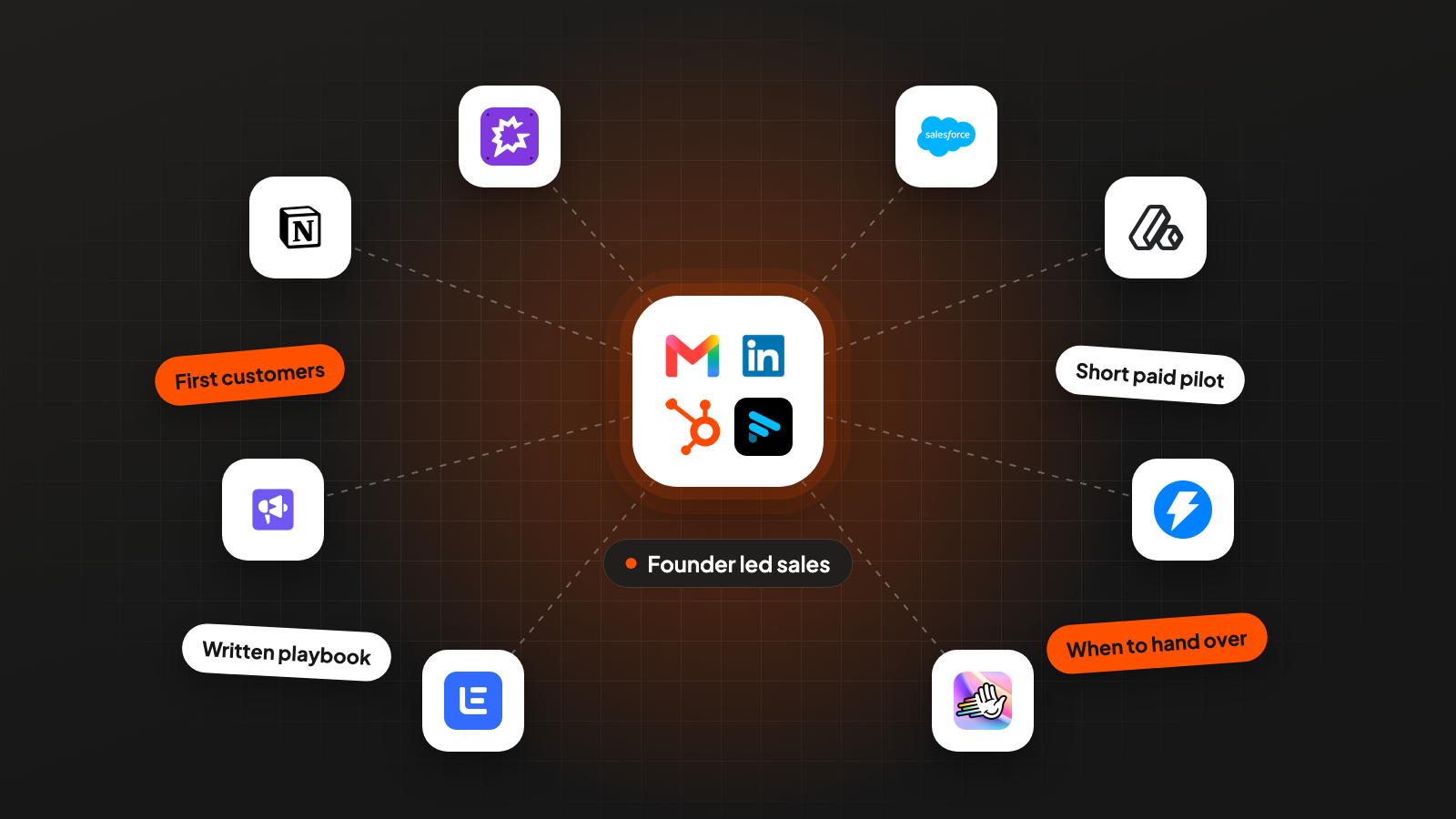
You have a product, a few people who said it looks useful and nobody whose job is sales. Advisors tell you to hire a salesperson. Before that hire can work, founder led sales has to answer the questions a new hire can’t answer for you: who buys, why now, what they pay and what makes them sign.
This guide covers what a founder should sell personally, how to run the first deals from a short list to a signed contract, what to write down along the way and the signs that it’s time to hand sales to someone else. Hiring the first salesperson, with timing and profile, is a separate decision and only comes up briefly here.
Key takeaways
- Founder led sales means the founder finds, pitches and closes the first customers personally. The goal is a sales process someone else can repeat, written down while you run it.
- Keep the jobs that need judgment about the buyer: the first segment, the first conversations, the price talk and the close. A tool or a helper can take over the list and the sending.
- Run every early deal the same way: a short list, a first conversation about the problem, a short pilot with one agreed success metric, then a contract with the next meeting already booked.
- Hand over when a new person could repeat your process from your notes: the same buyer, the same message, the same objections and deals that close without you on every call.
What founder led sales is
Founder led sales is the stage where a founder sells the product personally, before any salesperson joins the company. Pete Kazanjy, author of Founding Sales, defines it as “the process by which startup founders discover, refine, and scale their product’s initial sales motion.” His definition ends with “handing off this running sales machine to professional sales leadership.”
The hand-off is part of the definition. Founder led sales has an end point. You sell to learn what works, and you write it down so that someone else can do it after you.
Paul Graham made the same point in 2013. In his essay Do Things that Don’t Scale, he wrote that at least one founder “will have to spend a lot of time on sales and marketing” and that “you can’t avoid doing sales by hiring someone to do it for you.” His reason is the feedback. What you hear from your earliest users “will be the best you ever get.”
He also names why founders put it off: “a combination of shyness and laziness,” and the fact that “the absolute numbers seem so small at first.”
Trust is the second reason. An early product has gaps, and the buyer knows it. In a Y Combinator talk on early B2B sales, Tom Blomfield says that at this stage “you’re actually selling the founders and the early team” (YC Startup Library, 2025). A salesperson can promise a follow-up. Only you can promise that the product will change next week.
What a founder should sell personally
A founder should keep every job that needs judgment about the buyer and hand off the jobs that repeat the same way each time.
| Job | Who does it early | What to write down |
|---|---|---|
| Choosing the first segment | Founder | Why this segment, and who is out |
| Building and checking the list | Founder, a tool or a helper | Sources, filters, exclusions |
| First emails and connection requests | Sent under the founder’s name, a tool does the sending | Which first line got replies |
| First conversation | Founder | The buyer’s own words for the problem |
| Pilot and price terms | Founder | What they agreed to pay, and why |
| Close and onboarding | Founder | Who approved, how long it took |
Choosing the segment is the first sale you make. In a narrow segment, every conversation teaches you something about the next one. On a broad list, the answers mix, and you can’t tell which objection belongs to which kind of buyer.
The first conversation stays with you. Nobody else knows the product well enough to hear what is missing, and nobody else can change it. Graham describes how Stripe’s founders set people up on the spot: when someone agreed to try it, they said “Right then, give me your laptop.” That kind of fix in the room needs the person who builds the product.
The price talk also stays with you. Blomfield describes founders as “very afraid to have a willingness to pay conversation.” His suggestion is a direct question: if you solve this problem and hit the metrics you discussed, how much would that be worth to them. The answer tells you what the product is worth and whether the buyer is real.
The list and the sending can move first. Building the list, checking emails and running the sending tool repeat the same way for every account. A helper or a tool can do that work while the messages still go out under your name. Before the first send, check the list and set up sending domains that keep you out of spam.
Run a founder led sales strategy in five steps
A founder led sales strategy is one repeatable path from a short list to a signed contract, run the same way for every early deal.
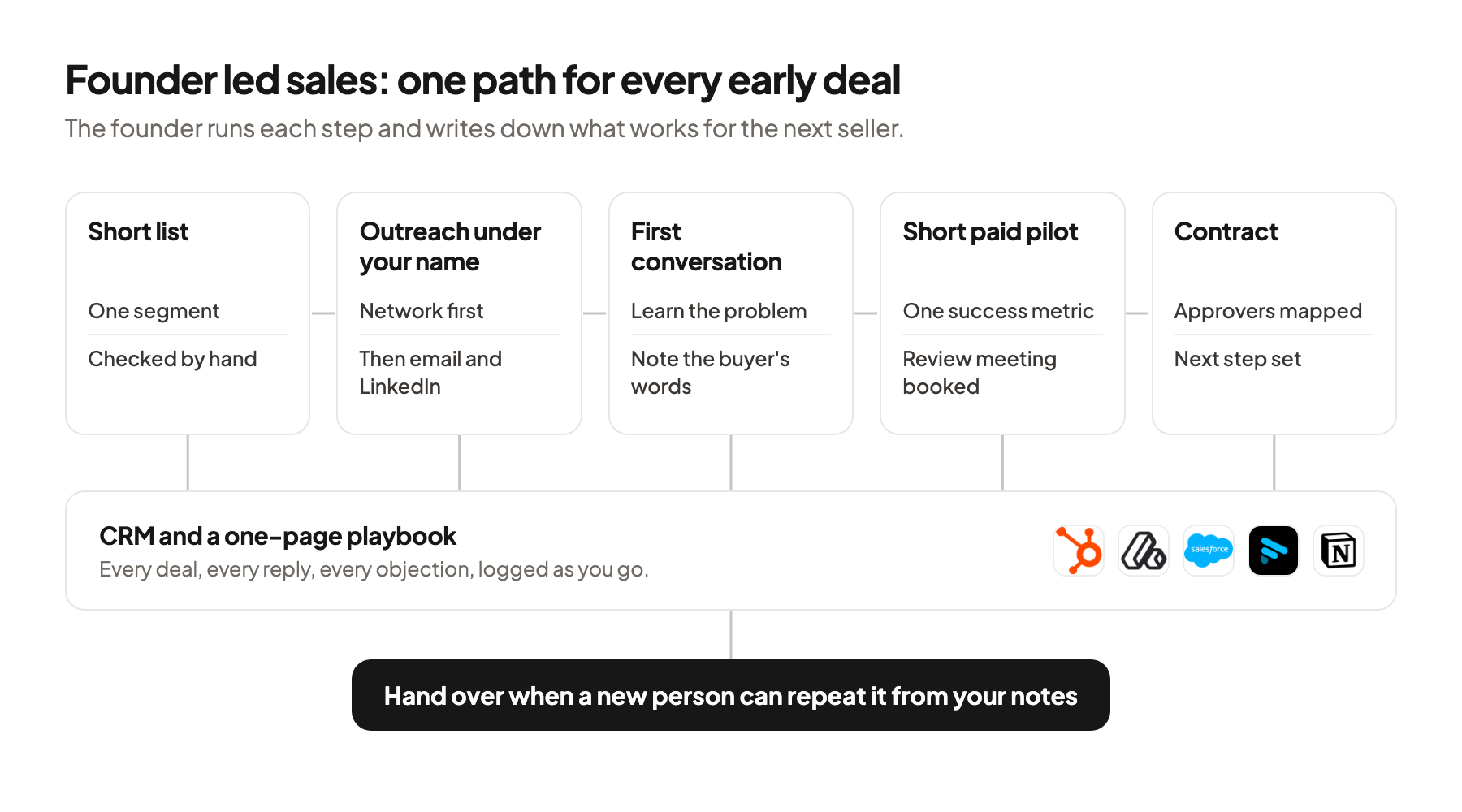
Step 1: pick one segment and build a short list. Start with companies that look like your best customers, or like the people who gave you the strongest feedback. Size the campaign before you write a word, so you know how many accounts the segment holds.
Say you sell shift-scheduling software to veterinary clinics. A first list could be 120 independent clinics in Colorado and Arizona with at least three vets, checked by hand. That is small enough to research every account and large enough to see a pattern in the replies.
Step 2: reach out under your own name. YC founders describe getting their first customer from “a cold email,” from LinkedIn and from their network. One put it this way: “As with a lot of founders, your first few customers come from your network” (YC Startup Library, 2023). Start with your network, then write to the list.
For email, keep the volume low per mailbox. Instantly’s help center (2026) recommends 30 campaign emails per day per email account. In the first email, I’d offer something useful, such as a short list of their likely customers, and build it only after they say yes, as in the give-first cold email. On LinkedIn, I’d send connection requests without a note and start the conversation by message once they accept. Free accounts can add a note to only a few requests per month anyway. The LinkedIn outreach guide has the rest.
Step 3: use the first conversation to learn the problem. Ask about their work before you show the product. Blomfield suggests asking which part of their job they hate most, and he says “you can even offer to do the work yourself manually for the customer so that you really understand what’s involved.” Write down the exact words the buyer uses. Those words go into your next email.
Step 4: run a short paid pilot with one success metric. A pilot is a time-boxed trial of your product with a real customer. Agree before the start what the pilot has to prove and which number counts as success. Blomfield warns that unpaid design partnerships, where a customer helps shape the product for free, often run three or six months with a vague scope and low engagement. He prefers a paid pilot, because “getting a financial commitment from the customer is going to make them take your pilot much, much more seriously,” and a short one: “Maybe that’s seven or 14 days if you’ve got the product dialed in really well.” Book the review meeting before the pilot begins.
Step 5: close, then set the next step. Ask how they bought similar software last time and who had to approve it. Blomfield lists the roles to map: “the economic buyer, the technical approver, the security gatekeeper, the legal team, the day-to-day users.” He also describes contracts that start with “a 30 or 60-day money back guarantee or opt-out period” and then run on by default. His rule for every meeting: “Don’t leave a meeting without the next touch point set up.”
After the signature, the work continues. Blomfield notes that onboarding can take “as much or even more effort” than the sale, and in founder led sales that work is yours too.
Write down what works while you sell
Log every deal in a CRM and keep your call notes, because those notes become the playbook the next seller starts from.
A free CRM is enough at this stage. A CRM is the software that holds your contacts and deals. HubSpot (2026) says its free CRM is “100% free, with no expiration date” and includes contact management, deal pipelines, email tracking and meeting scheduling. Attio, Pipedrive and Salesforce are other common choices. In HubSpot’s words, pipelines show “stages, which are steps that signal where a record is in a process.” Name the stages after what really happens in your deals: replied, first call, pilot agreed, pilot review, contract sent, closed.
Keep transcripts of your calls. HubSpot transcribes recordings for users on Sales Hub or Service Hub Professional or Enterprise seats, and you can search a transcript for a keyword. Fathom’s Ask Fathom answers questions across your calls from titles, summaries and transcripts. Either way, you get the buyer’s own words back when you write the next message.
Keep a one-page playbook next to the CRM. I’d use five headings:
- Who buys: the segment, the role and who is out.
- The problem in the buyer’s words.
- The first line and message that got replies.
- The objections, each with your answer.
- The pilot and price terms that got signed.
Update the page after every won or lost deal. A lost deal with a written reason tells the next seller more than a won deal with no notes.
Label every reply, including the no. In my view, replies belong back in the system as data. A “not now” with a reason and a date is a future deal. A “wrong person” with a name is the next email.
Founder led sales books worth reading
Four books and one essay cover most of what a founder needs, and each has a different focus.
| Book or essay | Author | What it covers, per the author or publisher |
|---|---|---|
| Founding Sales | Pete Kazanjy | “The Founder Led Sales & Early Stage Go-to-Market Handbook.” Part 1 goes “from 0 to ~30 customers” yourself, Part 2 gets others to do it too |
| The Mom Test | Rob Fitzpatrick | How to talk to customers and learn if your business is a good idea “when everyone is lying to you” |
| The Science of Scaling (2026) | Mark Roberge | A framework to decide whether you are ready to scale sales, and how fast, from your own performance data |
| The Sales Acceleration Formula (2015) | Mark Roberge | Hiring, training and managing salespeople to the same process, plus demand generation |
| Do Things that Don’t Scale (2013) | Paul Graham | Why founders recruit the first users by hand, and why that feedback matters |
I’d read them in the order you need them. The Mom Test before your first calls, because its subject is getting “more learning and more sales out of your customer conversations.” Founding Sales while you run deals, because its chapters follow the steps in this guide, from early prospecting to “Down-Funnel Selling: Negotiation, Closing, Pipeline Management.” The site lets you read it online after registering.
Roberge’s books belong to the hand-off. The Science of Scaling helps you decide whether you are ready to scale sales, and how fast, using your own performance data. The Sales Acceleration Formula is about what comes after the first hire, such as hiring “the same successful salesperson every time.”
When to hand over founder led sales
Hand over when the process works without you improvising on each call, and a new person could repeat it from your notes.
These are the checks I’d use before handing over any part:
- The same segment and the same role buy, and you can say who is out.
- One message gets replies often enough that you keep sending it.
- The objections repeat, and each has a written answer in the playbook.
- Pilots and contracts mostly follow the same terms.
- Deals close because of the product and the terms, with no special promise from you.
Kazanjy’s book draws the same line. Its second part is about “taking what you’ve proven can be done yourself, and getting others to do it, too.” Roberge names “Misunderstanding the GTM capabilities needed before hiring salespeople” as one of the mistakes his 2026 book addresses. GTM stands for go-to-market, the way a company finds and wins customers. In plain terms, the first seller needs a process to follow.
Hand over in pieces. The list and the sending can go first, then the first conversations, then pilots. I’d keep the largest deals and the price conversation longest, because that is where the founder’s word still matters most.
Who to hire, and when, is its own decision. For one example of how a fast-growing company staffs its early sales roles, see what Ramp’s job ads teach about first sales hires.
Where this usually goes wrong
- Running a long unpaid design partnership. Agree on one success metric and run a short, paid pilot instead.
- Avoiding the price conversation. Ask what solving the problem would be worth to them before the pilot starts.
- Hiring a salesperson before the process exists. Hand over once a new person could repeat it from your notes.
- Keeping what you learn in your head. Log every deal in the CRM and update the one-page playbook after each one.
- Pitching a call in the first email. Offer something useful and build it only after they say yes.
Where to start
This week, pick ten companies from your best-fit segment, write to them under your own name and log every reply in a free CRM. Start the one-page playbook with the first answer you get.
Founder led sales works when you run every early deal the same way and write down what you learn, so the next seller starts from a written process. If you’d like the list and sending side built on your own accounts while you keep the conversations, book a 30-minute system check.
Pick your next step
Build it yourself
If you have the time to build and maintain it. The guide walks through every step.
Get the free target market map
If you haven't run outbound yet. Your market, its buying signals and who to contact first.
Book a system check
If you want it built in your own tools. 30 minutes on your market, outbound and sales capacity.
FAQ
What is founder led sales?
Founder led sales is the stage where a founder finds, pitches and closes the first customers personally, before hiring salespeople. Pete Kazanjy defines it as the process by which founders discover, refine and scale their product’s initial sales motion. It ends with a hand-off to a sales team.
How long should a founder do sales?
Until a new person could repeat the process from your notes. That means the same buyer, a message that gets replies, written answers to the usual objections and terms that repeat. There is no fixed number of customers or months that fits every company.
What should a founder led sales strategy include?
One segment with a short list, outreach under the founder’s name, a first conversation about the problem, a short paid pilot with one success metric and a contract with the next step booked. Every step goes into a CRM and a one-page playbook.
Which founder led sales book should I read first?
The Mom Test before your first customer calls, then Founding Sales by Pete Kazanjy while you run deals. Mark Roberge’s books help when you think about scaling and hiring.
Can I hire an SDR or an agency instead of selling myself?
An SDR (sales development rep) or an agency can take over the list, the sending and booking first conversations, and in my view that is a good first hand-off. Paul Graham’s point still holds: you can’t avoid doing sales by hiring someone to do it for you. Pipecadence works this way too: the system brings conversations, and closing them stays with your team.
Do I need a CRM for founder led sales?
Yes, even a free one. HubSpot’s free CRM includes deal pipelines and contact management. The notes you log there become the playbook your first salesperson starts from.
Sources (13)
- Do Things that Don’t Scale, Paul Graham
- Founding Sales, Pete Kazanjy
- The Mom Test, Rob Fitzpatrick
- The Science of Scaling, Wiley
- The Sales Acceleration Formula, Wiley
- The Sales Playbook For Founders, Y Combinator
- Founder FAQ: How did you get your first customer?, Y Combinator
- HubSpot CRM, HubSpot
- Set up and customize pipelines, HubSpot
- Review call recordings and transcripts, HubSpot
- Using Ask Fathom, Fathom
- Campaign options, Instantly
- Connection requests with a personalized message, LinkedIn